Dental costs in Australia catch plenty of people off guard, mostly because nobody publishes a single price list. Each practice sets its own fees, Medicare stays out of most adult dental care, and health fund rebates depend on your level of extras cover. Still, the fee data the industry collects gives a fairly reliable picture of what you will pay for common treatments in 2026.
This guide pulls together typical fee ranges by treatment, using Australian Dental Association (ADA) item numbers, and explains how health insurance, public dental services and the Child Dental Benefits Schedule change the final bill.
Typical fees at a glance
The figures below are the middle of the market: the 25th to 75th percentile range from ADA fee survey data, as compiled by Compare Dentists in November 2026. Half of practices charge inside these ranges. A quarter charge less and a quarter charge more.
| Treatment | ADA item | Typical range | Mid-point guide |
|---|---|---|---|
| Comprehensive exam | 011 | $65 to $110 | $78 |
| Periodic exam | 012 | $55 to $90 | |
| Scale and clean | 114 | $110 to $180 | $140 |
| Two bitewing X-rays | 022 | $70 to $130 | |
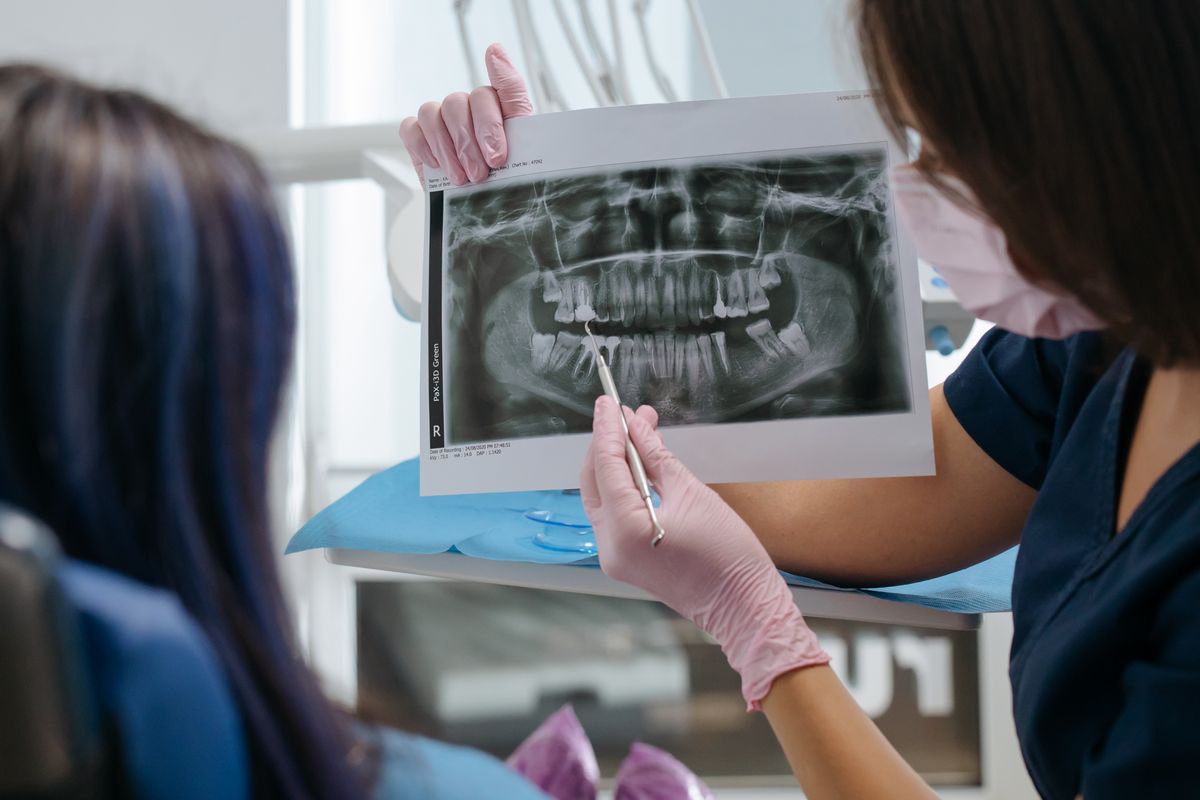
| OPG (full mouth X-ray) | 037 | $120 to $180 | |
| Fluoride | 121 | $35 to $75 | |
| One-surface white filling | 511 | $150 to $260 | $195 |
| Two-surface white filling | 522 | $220 to $360 | $280 |
| Simple extraction | 311 | $220 to $450 | $280 |
| Porcelain crown | 613/615 | $1,500 to $2,500 | $1,850 |
| Single implant (all stages) | Several | $3,500 to $6,000 | $4,800 |
Source: Compare Dentists, dental procedure costs, based on ADA fee survey data, 25th to 75th percentile (accessed November 2026). Mid-point guide is the average fee reported by Bupa where published.
Treat these as a guide only. A filling on a back tooth that needs extra time, a crown made by a premium lab, or a practice in a high-rent CBD can all push the price beyond the top of the range.

Why is there no standard price for dental care?
Unlike GP visits, dental care has no Medicare schedule fee for most adults, so there is nothing anchoring the price. The ADA publishes a schedule of item numbers that describes each service, but it does not set fees. Every practice decides what to charge for each item.
Several things drive the difference between practices:
- Overheads. Rent, staff wages, sterilisation and equipment such as digital scanners all cost money, and that cost lands in the fee.
- Time. A large filling on a molar takes longer than a small one on a front tooth. A difficult root canal takes much longer than a straightforward one.
- Lab work. Crowns, bridges, dentures and veneers are made in dental laboratories, and lab fees vary with materials and the technician.
- Specialist training. Endodontists, periodontists, prosthodontists, orthodontists and oral surgeons spend years training beyond general dentistry. Their fees tend to be higher, often by 30 to 60% for the same item, according to the Compare Dentists data.
- Location. City practices in high-rent areas often charge more, though competition can keep prices in check.
CHOICE has pointed out the same thing in its reporting on dental fees: two dentists in the same suburb can quote quite different amounts for the same work, so getting a second quote for anything expensive is reasonable.
What a check-up and clean costs
For most people the biggest regular dental cost is the routine check-up. A typical visit combines several items:
| Item | ADA code | Typical range |
|---|---|---|
| Comprehensive or periodic exam | 011 or 012 | $55 to $110 |
| Scale and clean | 114 | $110 to $180 |
| Two bitewing X-rays | 022 x 2 | $70 to $130 |
| Fluoride | 121 | $35 to $75 |
| Typical bundle | $280 to $480 |
Source: Compare Dentists, ADA fee survey data (accessed November 2026).
You won't always need every item. Many dentists take bitewing X-rays every one to two years rather than at every visit, depending on your risk of decay. Your first visit to a new practice is usually billed as a comprehensive exam (011), with later visits as periodic exams (012), which are a bit cheaper.
This is where health insurance makes the most noticeable difference. Many extras policies pay a large share of preventive items, and some funds offer no-gap check-ups at preferred-provider dentists, meaning you pay nothing for the exam, clean and fluoride. Annual limits still apply, so check yours.
Fillings and root canal treatment
Fillings are priced by how many surfaces of the tooth they cover. A one-surface composite (white) filling is about $150 to $260. A two-surface filling is $220 to $360, and a three-surface or larger one is about $290 to $430. Most practices now use tooth-coloured composite resin rather than silver amalgam.
Root canal treatment is a different scale of cost because it involves several appointments and careful work inside the tooth:
| Tooth | Typical total cost | Mid-point guide |
|---|---|---|
| Front tooth (anterior) | $950 to $1,700 | $1,240 |
| Premolar | $1,100 to $1,900 | |
| Molar | $1,300 to $2,800 | $1,750 |
Source: Compare Dentists, ADA fee survey data, general dentist fees (accessed November 2026).
Molars cost more because they have more canals, often three or four, and they're harder to reach. If your dentist refers you to an endodontist for a complex case, expect to pay more than these general dentist figures.
The root canal is often not the end of the bill. A back tooth that has had root canal treatment is often more brittle, and many dentists recommend a crown to protect it. That can add $1,500 to $2,500, plus $250 to $600 if a post and core build-up is needed. When you get a quote for a root canal, ask whether a crown is likely to follow so you can budget for both.
Crowns, bridges and implants
Replacing or rebuilding teeth is where dental bills climb into the thousands.
A porcelain or ceramic crown (items 613 and 615) usually runs $1,500 to $2,500 per tooth. Some practices with in-house milling machines make same-day crowns, and prices for those vary.
A single dental implant, covering the titanium post, abutment and crown, costs about $3,500 to $6,000, with a mid-point of around $4,800. That range assumes there is enough bone to hold the implant. If you need a bone graft first, add roughly $400 to $1,500. Full-arch options such as All-on-4, where a fixed set of teeth is anchored to four or so implants, are about $25,000 to $35,000 per arch.
Implant fees are often presented as a single package price, but they are billed as several items over months. Ask for the full itemised list, including the surgical stage, any graft, the abutment and the final crown, because extras policies may cover some of these items and not others. Many funds treat implants as major dental, which can come with lower annual limits and long waiting periods.
Extractions and wisdom teeth
| Procedure | Typical range | Mid-point guide |
|---|---|---|
| Simple extraction (311) | $220 to $450 | $280 |
| Surgical extraction (314) | $380 to $700 | |
| Impacted wisdom tooth, per tooth | $500 to $1,800 | $850 |
| All four wisdom teeth under general anaesthetic | $3,500 to $6,500 |
Source: Compare Dentists, ADA fee survey data (accessed November 2026).
A simple extraction of a tooth that has fully come through is quick and comparatively cheap. A surgical extraction, where the dentist needs to cut gum or remove bone, costs more. Impacted wisdom teeth sit at the top of the scale, especially when all four come out under general anaesthetic in a day hospital.
The general anaesthetic route brings extra bills from the oral surgeon, the anaesthetist and the hospital. If you have private hospital cover that includes dental surgery, part of the hospital and anaesthetist costs may be covered. Check your policy before you book, because dental surgery is excluded from some lower-tier hospital policies.
Orthodontics and cosmetic work
Orthodontics is a long-term cost spread over a year or more. Typical totals are:
- Clear aligners such as Invisalign, full treatment: about $6,500 to $9,000
- Traditional metal braces: about $6,000 to $9,500
Most orthodontists offer payment plans, and many extras policies include a lifetime orthodontic limit per person, often after a long waiting period.
Cosmetic treatments are almost never covered by health funds:
- In-chair teeth whitening: about $500 to $1,200
- Porcelain veneers: about $1,800 to $2,800 per tooth
Because these are elective, take your time and compare quotes. A cheaper veneer that needs replacing early may end up costing more than a better one.
Does Medicare cover any dental care?
Medicare doesn't pay for routine dental care for most adults. There are a few important exceptions.
The Child Dental Benefits Schedule (CDBS). Eligible children aged 0 to 17 whose families receive certain government payments, such as Family Tax Benefit Part A, can get basic dental services covered up to a capped amount over two calendar years. Services Australia tells eligible families when they qualify. Many dentists bulk bill CDBS services, which means no out-of-pocket cost for covered items. The CDBS doesn't cover orthodontics, cosmetic work or treatment in hospital.
Public dental services. Each state and territory runs public dental clinics, generally for adults with a concession card and for children. Fees are low or nil, but waiting lists for routine care can be long, and emergency cases are seen first. NSW Health, for instance, runs public oral health services through local health districts and assesses patients on clinical need.
Hospital dental surgery. Some dental procedures in public hospitals, such as treatment for injuries or as part of other medical care, are covered under the public system.
For everyone else, the money comes from your own pocket or your extras cover. The Australian Institute of Health and Welfare tracks how often people delay dental visits because of cost, and its reports show cost is one of the main reasons Australians put off seeing a dentist.

How much does health insurance actually save?
Extras cover helps with dental costs, but it rarely covers everything. Policies usually work like this:
- General dental (exams, cleans, X-rays, fillings, simple extractions) is included in most extras policies, often with a short waiting period of two months or so.
- Major dental (crowns, bridges, root canals, implants, surgical extractions) usually needs a longer waiting period, commonly 12 months, and may have its own annual limit.
- Orthodontics typically has a lifetime limit and a long waiting period.
Funds pay a set benefit per ADA item, or a percentage of the fee up to an annual limit. The gap between that benefit and the dentist's fee is what you pay. Preferred-provider dentists agree to set fees with a fund, which can reduce or wipe out the gap. Figures compiled from ADA fee data suggest these networks cut out-of-pocket costs by anywhere from nothing to about 30%, depending on the item and the fund.
The government's private health information site, privatehealth.gov.au, lets you compare extras policies and see what each one covers, including annual limits for dental. It is worth checking whether your premiums for extras add up to more than you claim each year.
A worked example
Take an adult without extras cover who needs a check-up and turns out to have one cavity on a back tooth needing a two-surface filling. Using the middle of each range:
| Item | Estimated fee |
|---|---|
| Comprehensive exam (011) | $78 |
| Scale and clean (114) | $140 |
| Two bitewing X-rays (022 x 2) | about $100 |
| Two-surface filling (522) | $280 |
| Total | about $598 |
Source: estimates built from Compare Dentists ADA fee survey mid-points (accessed November 2026). Your fees will differ.
With mid-level extras cover, the fund might pay a large share of the exam, clean and X-rays and part of the filling, leaving a smaller gap. Without cover, the full amount is due on the day at most practices. If that's a stretch, ask whether the practice offers a payment plan before treatment begins.
How to keep dental costs down
A few habits make a real difference to what you spend over the years:
- Keep up with check-ups. A $195 filling caught early is far cheaper than a $1,750 root canal plus a $1,850 crown later.
- Ask for an itemised quote. Request a written treatment plan listing each ADA item number and fee. This lets you check your rebate with your fund and compare practices fairly.
- Compare for big jobs. For crowns, implants or orthodontics, a second opinion and quote is normal practice. In western Sydney, for example, Penrith Dental Clinic can talk you through an itemised treatment plan before you commit.
- Use your annual limits wisely. Extras limits often reset on 1 January or on your membership anniversary. Splitting non-urgent treatment across two benefit years can help.
- Check public options if you're eligible. Concession card holders and eligible children may get care through public clinics or the CDBS at little or no cost.
- Look at dental schools. Some university dental schools offer supervised treatment by students at reduced fees. Appointments take longer, but costs can be lower.
Be wary of choosing a dentist on price alone. Check that the dentist is registered with the Dental Board of Australia, which you can do through the Ahpra public register, and ask how many times they have done the procedure you need.
Questions to ask before treatment
Before any treatment over a few hundred dollars, it helps to have answers to these:
- What are the ADA item numbers and fees for each step?
- How many appointments will it take, and is there a lab fee included?
- Will I need further treatment later, such as a crown after a root canal?
- What happens if a complication adds time or work?
- Do you offer a payment plan, and are you a preferred provider for my fund?
- Is there a less expensive option that is still clinically sound?
A good dentist will be happy to explain each item. If something is unclear or the quote seems high, it is fine to take the plan home and think about it before booking. The ADA also publishes plain-language consumer information explaining common treatments.
If you do one thing
Dental costs in Australia depend on the practice, the treatment and your cover, but the ADA survey data gives a useful yardstick. Budget roughly $280 to $480 for a full check-up, $150 to $430 for a filling, and four figures for root canals, crowns and implants. Medicare helps only eligible children through the CDBS, and public clinics serve mainly concession card holders, so extras cover and preferred-provider dentists are the main way most adults cut the bill. Get an itemised quote with ADA item numbers before any major work, check it against your policy, and keep up with check-ups so small problems stay small and affordable.
Sources
- Compare Dentists: Dental procedure costs in Australia
- CHOICE: Dental fees
- Australian Dental Association
- Services Australia: Child Dental Benefits Schedule
- Department of Health, Disability and Ageing: Child Dental Benefits Schedule
- privatehealth.gov.au: Compare health insurance policies
- AIHW: Oral health and dental care in Australia
- NSW Health: Oral health services
- Dental Board of Australia